 RESEARCHOpen ThesisMemo
What the order establishes
HPE announced on September 30, 2026 that Vultr ordered $1.2 billion of AMD Helios AI Rack by HPE systems for US data centers. HPE describes it as its first order for the platform. The announcement gives researchers a named customer and a stated commercial value. It does not establish that the equipment has already generated that amount of revenue or that the customer has put the entire installation to work.
Our interpretation is that the immediate research value lies in the transition from a platform proposition to a specific customer commitment. The next question is how that commitment becomes operating capacity and, eventually, financial results. Those steps should stay separate in a company research note. A purchase announcement can improve visibility while still leaving the timing and profitability of execution unresolved.
Keep the evidence narrow. The order release does not provide a rack count, a unit-price schedule or a detailed delivery calendar. An analyst cannot recover those missing terms simply by dividing the headline value by an assumed hardware price. Such a calculation would produce a scenario built on an invented input, rather than a disclosed fact about this transaction.
Look at the system, not only its accelerators
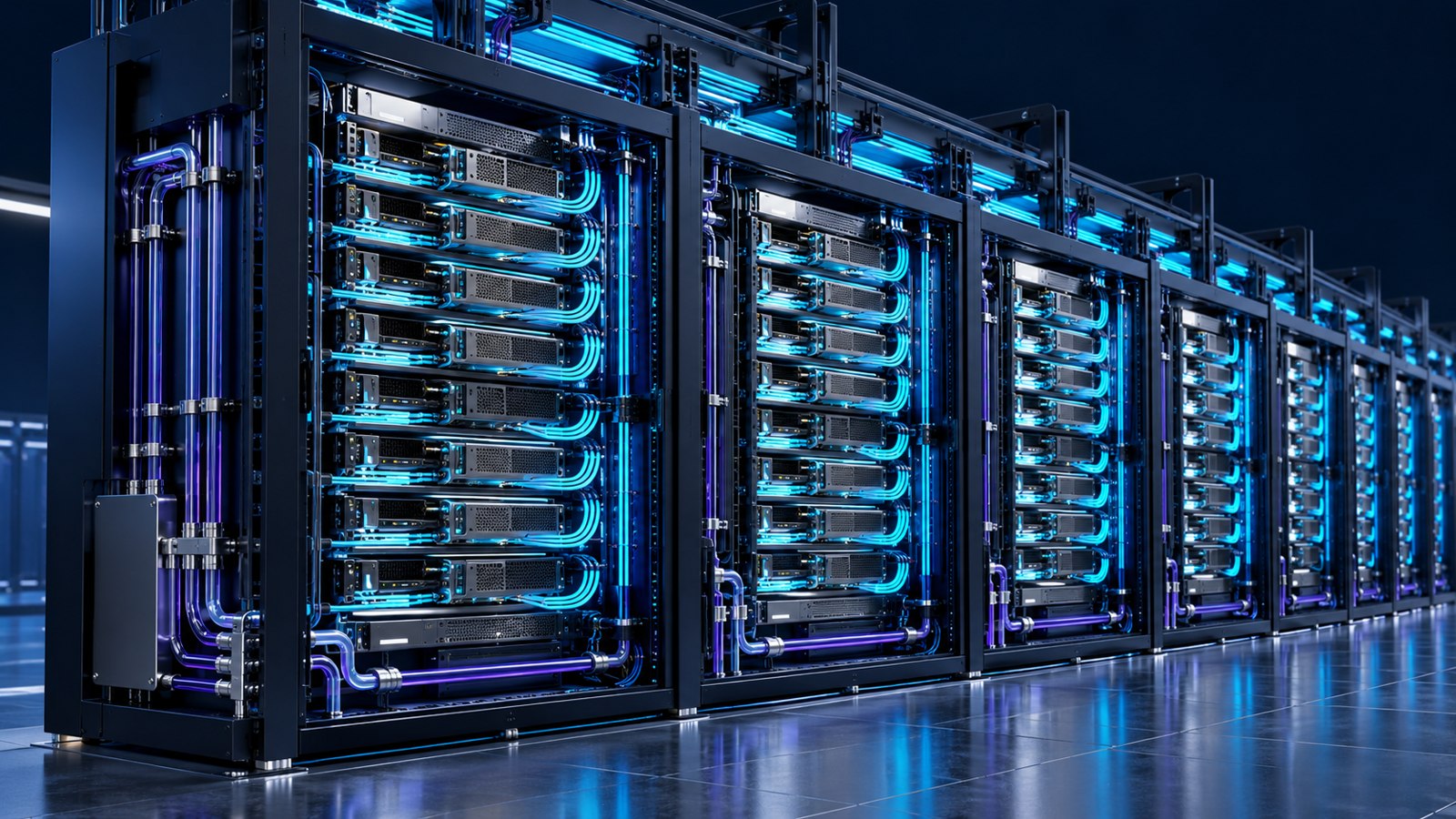
HPE lists 72 MI455X GPUs per rack, alongside EPYC Venice CPUs, Pensando networking and ROCm software. It also specifies six Juniper QFX5252 scale-up switch trays per rack and deployment services involving liquid cooling. These are HPE’s stated system details, not independently measured performance results.
AMD’s Helios architecture page separately describes the integration of compute, networking, power and cooling. That helps explain why this is a system-level research question. Hardware that performs well in isolation still needs an installation capable of supporting the intended workloads. This observation is an analytical framework, not a claim that Vultr has encountered a particular bottleneck.
For research, create separate questions for component supply, site readiness, software validation and customer access. A delay in one area need not mean the underlying chip design failed; equally, delivery of chips would not alone establish that an entire cloud service is ready. Ask what operational milestone a future announcement actually proves before moving every part of the project forward in a forecast.
The same distinction applies to economics. The aggregate system value is not a disclosed allocation of proceeds to AMD, HPE’s networking business or services. Treating the whole amount as semiconductor revenue would conflate different participants and different items in the offering.
Continue your research with ThesisMemo.
See how ThesisMemo works Explore the product · Start with a free research previewKeep the earlier capacity announcement in its own time frame
Vultr had already discussed Helios support in a July 23, 2026 post. That earlier page offers reservations for capacity associated with deployments in 2027 through 2028. It is useful historical context, but it is not a delivery schedule for the September 30 HPE order. The two documents describe related activity with different dates and purposes.
A practical evidence log should therefore retain both entries. Label one as the earlier cloud-capacity plan and the other as the newly announced equipment order. Do not replace the missing contract schedule with the earlier reservation window, and do not present the July post as fresh September news.
This discipline prevents two common mistakes: counting a previously announced ambition as a second independent demand event, and assigning revenue to a quarter based on a product availability statement. The appropriate next source would be an explicit update connecting this order to shipments or deployment milestones. Until then, the timing field should remain unresolved rather than filled with a convenient estimate.
Separate commercial evidence from workload economics
The order is meaningful commercial evidence, but a cloud infrastructure purchase and the profitability of serving its end customers answer different questions. For a research model, distinguish installed capacity, capacity available for reservation, capacity actually used and payments collected. These categories are a checklist for future evidence, not reported measurements of Vultr’s operations.
Consider the questions a prospective customer might ask: Does the software stack support its model? Can it obtain the required cluster size? What service terms apply? How does the application perform under its own latency and reliability requirements? A general architecture description cannot answer all of them. Vendor specifications should be retained as specifications until suitable workload evidence is available.
Similarly, avoid inserting an assumed utilization rate or cloud rental price into a profitability conclusion without showing where the input came from. If a scenario is useful, label it explicitly, explain its sensitivity and keep it out of the reported-facts column. The order announcement alone supplies neither a demonstrated customer return nor a comprehensive picture of project financing.
What to check in the next update
For HPE, follow subsequent disclosures that clarify shipment progress, recognized sales and the associated business mix. Read the accounting context before equating an order, a shipment and cash collection. If management discusses a broader AI pipeline, check whether the Vultr commitment is included before adding it to another total. This is a double-counting check, not a claim that any published total is wrong.
For the deployment itself, look for a dated statement that specific capacity is available and evidence about the workloads it serves. Separate limited availability from a completed rollout. For AMD-related research, seek company disclosures rather than assigning the whole system contract to the chip supplier.
The useful conclusion is a defined milestone with a defined evidence gap. HPE has announced a substantial named-customer order; the subsequent delivery and financial outcomes require their own verification. Keeping those stages distinct makes the next earnings discussion easier to evaluate and prevents a strong headline from becoming an unsupported earnings forecast.
Turn your next headline into a better research question.
Discover a workspace for company research, market context, news and original filings. See how ThesisMemo fits into your research process.
See how ThesisMemo works Explore the product · Start with a free research preview- HPE investor relations: September 30 Vultr order announcement ↗
- Vultr: July 23 Helios support and capacity reservations ↗
- AMD: Helios system architecture ↗
Research and education, not personalized investment advice. Facts and examples should be read in the context of their stated periods. Follow the original disclosures for the complete record.